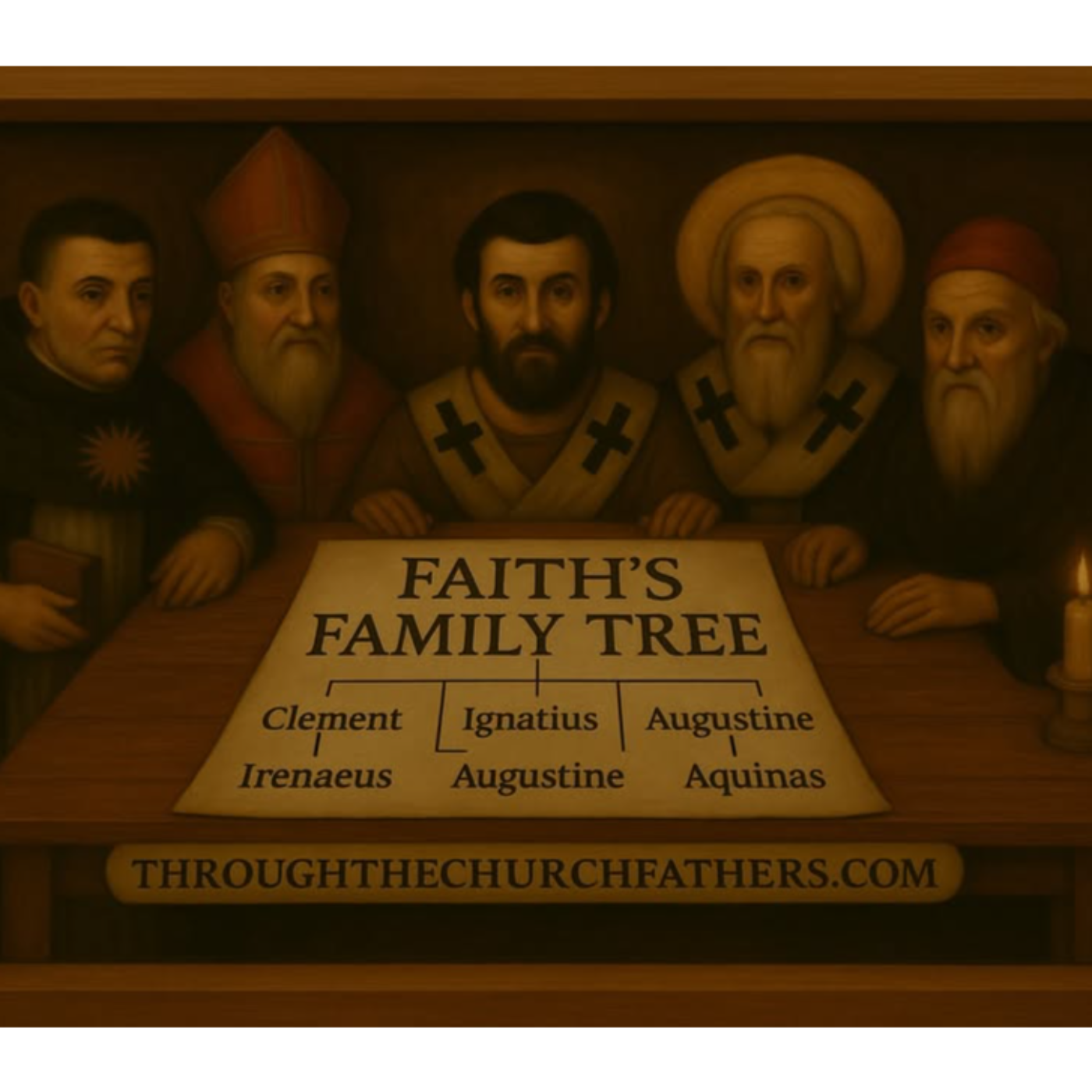
Through the Church Fathers
By: C. Michael Patton
Language: en
Categories: Religion, Spirituality, Christianity, History
Join Through the Church Fathers, a year-long journey into the writings of the early Church Fathers, thoughtfully curated by C. Michael Patton. Each episode features daily readings from key figures like Clement, Augustine, and Aquinas, accompanied by insightful commentary to help you engage with the foundational truths of the Christian faith.Join Our Community: Read along and engage with others on this journey through the Church Fathers. Visit our website.Support the Podcast: Help sustain this work and gain access to exclusive content by supporting C. Michael Patton on Patreon at patreon.com/cmichaelpatton.Dive Deeper into Theology: Explore high-quality...
Episodes
Through the Church Fathers: January 11
Jan 11, 2026Today’s readings bring us face to face with how the early Church understood faith as something lived, ordered, and grounded in the very being of God. In the Didache, the Church lays out practical wisdom for discerning true teachers, caring for the poor, gathering rightly on the Lord’s Day, and remaining watchful as we await Christ’s return—showing that doctrine and daily life were never separated. Augustine then looks back on his own childhood in The Confessions, exposing how even youthful innocence is already bent toward disordered love, yet sustained entirely by God’s gracious gifts. Aquinas fi...
Duration: 00:09:46Through the Church Fathers: January 10
Jan 10, 2026Today’s reading moves us from the earliest moral catechesis of the Church, through Augustine’s searching critique of human education, and into Aquinas’s most famous demonstration of God’s existence. The Didache confronts us with the stark contrast between the way of life and the way of death, grounding Christian ethics in concrete obedience, disciplined worship, and ordered community—where baptism, prayer, Eucharist, and discernment of teachers are inseparable from holiness of life. Augustine then exposes the tragic irony of human learning: that people will guard grammatical precision while neglecting the eternal law written on the conscience, caring mor...
Duration: 00:15:28Introduction to the Didache
Jan 09, 2026In today’s reading, we are introduced to the Didache, one of the earliest Christian documents outside the New Testament, likely composed near the end of the first century as a practical manual for church life. Rather than offering theological speculation, the Didache shows us Christianity as it was lived—teaching converts how to walk in the “Two Ways,” how to pray the Lord’s Prayer daily, how to baptize, fast, receive the Eucharist, discern traveling prophets, and appoint local overseers. What emerges is a church that is deeply biblical, morally serious, sacramental in practice, and already ordered—yet still close...
Duration: 00:04:57Through the Church Fathers: January 9
Jan 09, 2026In today’s reading, we move from the pastoral urgency of Clement of Rome, through Augustine’s piercing self-examination of education and desire, and finally into Aquinas’s careful demonstration of God’s existence. Clement pleads for repentance, humility, and sacrificial love, showing that true unity in the Church is preserved not by power but by confession, submission, and willingness to suffer for peace (Psalm 24:1). Augustine then exposes the moral danger of pagan education, arguing that poetic eloquence without truth trains the heart toward vice rather than virtue, and that brilliance without devotion becomes “smoke and wind” (Psalm 118:18). Aquinas completes th...
Duration: 00:12:15Through the Church Fathers: January 8
Jan 08, 2026Confession, humility, and peace are not abstract virtues but costly acts of love that preserve the life of the Church. Clement of Rome confronts division head-on, calling those who caused strife to repent, submit, and even suffer loss for the sake of unity, grounding his exhortation in Scripture and in the self-sacrificial examples of Moses, Judith, and Esther (Psalms 24:1; 50:14–15; 51:17; Exodus 32:32; Proverbs 1:23–31). This concludes our time in Clement. Augustine reflects on how fear stifles learning while love awakens the soul, showing that discipline heals only when it leads us back to God, not when it hardens the heart (Psalm 118:18; Proverbs 3:12; Hebr...
Duration: 00:13:16Through the Church Father: January 7
Jan 07, 2026Today’s readings confront division at its root and answer it with love, humility, and depth of meaning in Scripture itself. Clement of Rome warns the Corinthians that removing faithful presbyters and fueling factionalism is not merely disorderly but destructive to the body of Christ, reminding them that schism always arises from pride and is healed only through repentance and love that seeks the common good (Psalm 32:1–2). Augustine of Hippo deepens this diagnosis by confessing how his own early education trained his emotions to weep over fictional tragedies while remaining blind to his own spiritual death, revealing how misdirected love...
Duration: 00:17:10Through the Church Fathers: January 6
Jan 06, 2026Today’s readings trace how God orders His people through Christ, discipline, and reasoned faith. Clement of Rome insists that all blessing, authority, and order flow through Jesus Christ alone, showing how unity in the Church depends on humble submission to God’s appointed structure rather than self-conceit or rivalry (Hebrews 1:3–4; Psalm 110:1). Augustine of Hippo reflects on his childhood love of games and spectacles, confessing that beneath his delight in play and delayed baptism lay a deeper disorder of love, where even parental discipline became an instrument God used to restrain greater harm and preserve his soul amid looming tempta...
Duration: 00:15:52Through the Church Fathers: January 5
Jan 05, 2026Today’s readings press us into the heart of Christian life by holding faith, humility, and obedience together without confusion or compromise. Clement of Rome reminds us that while we are justified by faith and not by our own works, this faith never excuses sloth, pride, or neglect of righteousness, but instead energizes love, discipline, and harmony within the Church (Psalm 25:9; Isaiah 64:6; Habakkuk 2:4). Augustine reflects on his early years to show how human formation is marked by disordered loves even in childhood, revealing both our dependence on authority and our deep need for grace to rightly order desire, learning, an...
Duration: 00:14:29Through the Church Fathers: January 4
Jan 04, 2026In today’s reading, Clement of Rome exhorts the Church to perseverance, humility, and hope in the resurrection, grounding obedience in faith, Scripture, and God’s faithful promises, even pointing to creation itself as a witness to life restored. Augustine of Hippo turns inward, confessing that even infancy bears the mark of disordered desire and praising God as Creator and sustainer of life, whose mercy precedes memory itself. Thomas Aquinas then clarifies that sacred doctrine, though it directs human action, is chiefly speculative and surpasses all other sciences because it knows God through divine revelation and orders every truth towa...
Duration: 00:14:45Through the Church Fathers: January 3
Jan 03, 2026Today’s readings draw a single line through the early Church, Augustine’s confession, and Aquinas’s theology: humility before God’s revealed truth. Clement of Rome calls the Church back to peace, obedience, and repentance through the humility of Christ and the power of His blood. Augustine of Hippo turns inward, confessing that God is nearer than the soul’s own depths and the only source of true life. Thomas Aquinas then shows how sacred doctrine holds together as one science, uniting all things under the single light of divine revelation ordered to God.
Readings:
1 Clemen...
Duration: 00:08:20Through the Church Fathers: January 2
Jan 02, 2026Repentance, humility, resurrection, and ordered love form the backbone of the Christian life—and they are not learned all at once. Today’s readings press deeper into the moral and spiritual logic of the early church, revealing how God patiently calls His people back to unity, how the soul longs to be gathered into God Himself, and how sacred doctrine stands as a true science grounded in divine light.
Readings:
Clement of Rome, 1 Clement, Sections 8–15
Augustine of Hippo, The Confessions, Book 1, Chapter 1 (3–4)
Thomas Aquinas, Summa Theologica, Part 1, Question 1, Article 2
Explore...
Duration: 00:09:28Through the Church Fathers: January 1
Jan 01, 2026From division and disorder to earnest pursuit of holiness, today’s readings trace the early Church’s struggle and hope in Christ, beginning with Clement of Rome, 1 Clement, Sections 1–7, where Clement appeals to the Corinthians to repent, restore unity, and fix their gaze on the blood of Christ that makes mercy available to the whole world. Then we turn to Augustine of Hippo, The Confessions, Book 1, Chapter 1 (1), where Augustine opens his soul to God in prayer, confessing our restless hearts and the gracious mercy that draws us into true praise. We conclude with Thomas Aquinas, Summa Theologica, Part 1, Question 1, Articl...
Duration: 00:10:26Introduction to Thomas Aquinas
Jan 01, 2026What happens when faith refuses to fear reason? In this episode, we introduce Thomas Aquinas and his Summa Theologica, one of the most ambitious and demanding works in the history of Christian thought. Aquinas asks the questions many of us are afraid to articulate—about God, existence, evil, angels, freedom, and the soul—and then patiently works through every possible objection with relentless clarity. This is the most intellectually challenging portion of Through the Church Fathers, but it is also one of the most rewarding. Take it slowly. Over time, Aquinas begins to teach you how to think, not just...
Duration: 00:05:42Introduction to Saint Augustine
Jan 01, 2026Augustine’s Confessions is not a theological textbook—it is a soul laid bare before God. In this episode, we introduce one of the most honest spiritual works ever written, where Augustine speaks directly to God about sin, memory, desire, grace, and mercy. This daily reading functions as the devotional heartbeat of Through the Church Fathers, reminding us that theology begins not with mastery, but with repentance. Augustine does not confess to impress us; he confesses because he cannot stand before God without mercy—and neither can we.
Explore the Project:
Through the Church Fathers – https...
Duration: 00:05:53Introduction to Clement of Rome
Jan 01, 2026Before creeds were settled and councils convened, the Church learned how to survive conflict, persecution, and division through faithful shepherds who stood close to the apostles themselves. In this introduction to 1 Clement, we step into the late first century—only decades after the resurrection—and meet a church leader writing not theory but urgent pastoral counsel. Clement’s letter to Corinth shows us what authority, unity, and humility looked like before Christianity had power, buildings, or legal standing. This opening reading sets the tone for our journey through the Church Fathers: grounded in history, saturated with Scripture, and centered on the...
Duration: 00:04:17What to Expect this Year
Jan 01, 2026What does it mean to read Christianity as history, not theory? In this opening episode, we lay out what to expect in the year ahead as we journey through the Church Fathers together. Each day follows a simple rhythm: a primary reading from an early Church Father, a short devotional passage from Augustine’s Confessions, and a carefully chosen theological reading from Thomas Aquinas’s Summa Theologica. Whether you read or listen, this project is designed for the whole Church—Catholic, Protestant, and Orthodox alike—grounded in our shared confession that Jesus Christ lived, died, and rose again. This is an in...
Duration: 00:03:29Voices of Proclaiming the Incarnation: A Christmas Liturgy of Readings
Dec 25, 2025Voices Proclaiming the Incarnation is a communal Christmas liturgy designed to be read aloud—together. Drawing from Scripture, the early Church Fathers, and the great creeds of the Church, this reading traces the mystery of the Incarnation from prophecy to fulfillment, from the manger to the cross, and from history to hope. Twenty readings are shared among the group, with a congregational refrain spoken together between each proclamation, allowing many voices to bear witness to one Christ. This is not a performance or a lecture, but an act of shared confession: the Word has become flesh, and God is wi...
Duration: 00:10:08Through the Church Fathers: December 25
Dec 24, 2025Final Broadcast of the Year
In today’s reading from On the Incarnation (Sections 53–57), Athanasius brings his great work to a close by pointing to the most astonishing evidence of all: the quiet but total overthrow of the pagan world from within the human conscience itself. Without armies, force, or spectacle, Christ has dismantled idolatry, silenced oracles, exposed demons, emptied magic of its power, and eclipsed the wisdom of the Greeks—not by argument alone, but by transforming lives. Those who once mocked the Cross now worship the Crucified as God; magicians burn their books; philosophers give way to...
Duration: 00:08:01Through the Church Fathers: December 24
Dec 24, 2025In today’s Christmas Eve reading from On the Incarnation (Sections 46–52), Athanasius draws the final lines of his argument by pointing not merely to Scripture, but to the visible collapse of the old world and the undeniable rise of the new. Since the coming of Christ, idolatry has withered, oracles have fallen silent, demons have been driven out, magic has been exposed, and the proud claims of Greek philosophy have been eclipsed. What was once local, divided, and powerless has given way to a single, universal worship of Christ across every nation. Athanasius presses the point with force: no mere...
Duration: 00:16:39Through the Church Fathers: December 22
Dec 22, 2025From now until Christmas, our Early Church Fathers Track is turning all our attention to Athanasius’s On the Incarnation, letting his voice prepare us for the mystery of the Word becoming flesh (John 1:14). Today we hear him dismantle every objection—Jewish, pagan, philosophical—showing that Christ’s coming is the hinge of history, the end of prophecy, the downfall of idols, and the dawning of light for the nations (Isaiah 9:2). As we enter Advent, we’re walking slowly and reverently through this single work to let its truth settle deep. After December 22, we will take one week away from podca...
Duration: 00:07:56Through the Church Fathers: December 23
Dec 21, 2025In today’s reading from On the Incarnation (Sections 39–45), Athanasius presses the question of Christ’s identity with relentless clarity, drawing together prophecy, history, reason, and the visible transformation of the world. Beginning with Daniel’s prophecy of the seventy weeks, he argues that Scripture itself fixed the time of the Messiah’s coming and declared that prophecy, kingship, and Jerusalem itself would cease once the Holy of Holies had appeared (Daniel 9:24–25). Athanasius shows that this has already happened: there is no king, no prophet, no vision, and no temple among the Jews, while the nations now worship the God of Israe...
Duration: 00:16:44Through the Church Fathers: December 21
Dec 21, 2025Today’s readings press us right up against the heart of the Christian confession, where Athanasius keeps insisting that the Cross and Resurrection are not ideas to ponder but facts that reshape reality (Romans 4:25). Augustine then pulls us into the mystery of desire itself, reminding us how hungry we are for God even when our lives pull us toward lesser loves (Psalm 42:1). Aquinas closes the day by lifting our gaze above the visible world to the ordered work of the angelic hosts, showing how every good action in creation echoes the goodness of the God who sends them (Hebrews 1:14). Th...
Duration: 00:19:12Through the Church Fathers: December 18
Dec 21, 2025Athanasius 12–14 • Augustine Letter 12 • Aquinas Q61.3
Today’s readings pull us into the question of what counts as adequate proof of God’s majesty: Athanasius reminds us that the Incarnation brought new works into the world, not a new world; Augustine unfolds how Christ’s teaching corrected human pride and restored the soul’s desire for God; and Aquinas explains why the four cardinal virtues stand as the foundational pillars of the moral life (John 1:1–3).
Readings:
Athanasius, On the Incarnation, Sections 12–14
Augustine, Letter 12, Sections 13–14
Thomas Aquinas, Summa Theologica, Part 1–2, Question 61, Article 3
Explor...
Duration: 00:17:16Through the Church Fathers: December 20
Dec 20, 2025The cross has altered our entire relation to death, turning what once terrified the world into something mocked, trampled, and ultimately defeated in the lives of ordinary believers who now rush toward martyrdom with unshakable confidence. Athanasius explains how Christ’s victory displays itself in His people, how doubt collapses under the weight of lived evidence, and how the triumph of the cross is as self-evident as sunrise. Augustine then reflects on Scripture’s unique ability to teach all minds—simple or learned—by speaking plainly and hiding depths in mystery, before offering pastoral counsel on endurance, hope, and the heav...
Duration: 00:12:31Through the Church Fathers: December 19
Dec 19, 2025He chose the cross not because it was noble but because it was the very death His enemies prepared for Him, and by conquering what they deemed most shameful He showed Himself Lord of every death. Today Athanasius leads us through the logic of the crucifixion—why He did not select a “glorious” death, why only the cross could bear the weight of salvation, and why resurrection on the third day struck the perfect blow against unbelief. Augustine then lifts our eyes to the long arc of sacred history, showing how Abraham, Israel, the prophets, and the nations converge in the...
Duration: 00:14:26Through the Church Fathers: December 17
Dec 17, 2025Athanasius 21–23 • Augustine Letter 12 • Aquinas Q61.2
The thread running through today’s readings is the sheer nearness of Christ: in Athanasius we watch Him destroy death by refusing both secrecy and sickness; in Augustine we see the Word’s incarnation as the moment when eternal Wisdom stepped into the world to steady even the weakest mind; and in Aquinas we watch the moral life take shape through prudence, the virtue that orders every practical decision (1 Corinthians 15:53–55).
Readings:
Athanasius, On the Incarnation, Sections 21–23
Augustine, Letter 12, Sections 12–14
Thomas Aquinas, Summa Theologica, Part 1–2, Question 61, Artic...
Duration: 00:19:46Through the Church Fathers: December 16
Dec 16, 2025Today’s readings move from incarnation to intellect to virtue: Athanasius reveals how the Word met humanity at its lowest point, taking flesh while remaining present everywhere; Augustine begins his powerful exchange with Volusianus by showing how reason itself witnesses to God’s nature; and Aquinas opens his treatment of the cardinal virtues, explaining why prudence, justice, fortitude, and temperance stand at the hinge of the moral life (1 Corinthians 1:21).
Readings:
Athanasius of Alexandria, On the Incarnation, Sections 15–17
Augustine of Hippo, Letter 137 to Volusianus, Sections 1–5 (Part One)
Thomas Aquinas, Summa Theologica, Part 1–2, Question 6...
Duration: 00:15:35Through the Church Fathers: December 15
Dec 15, 2025The thread running through today’s readings is the sheer generosity of God: Athanasius shows how the Word pursued humanity through creation, prophecy, and finally by taking a body; Augustine teaches that prayer itself is a school of desire drawing us toward the life to come; and Aquinas explains how moral virtues differ because different parts of us need to be healed and ordered by reason (Romans 8:24).
Readings:
Athanasius of Alexandria, On the Incarnation, Sections 12–14
Augustine of Hippo, Letter 130 to Proba (Final Sections)
Thomas Aquinas, Summa Theologica, Part 1–2, Question 60, Article 5
Expl...
Duration: 00:13:17Through the Church Fathers: December 14
Dec 14, 2025Athanasius leads us deeper today into the logic of the Incarnation, showing that God’s goodness would not allow His creation to remain in darkness and idolatry, while Augustine continues Letter 130 with his careful reflection on vows, reputation, and the serious pastoral weight of keeping one’s word before God and His people, and Aquinas teaches that there cannot be only one moral virtue governing all human operations, because the will reaches toward many different kinds of goods and must be rightly shaped in each distinct area of life (Romans 1:25; Hebrews 2:14–15; Genesis 1:1).
Readings: Athanasius, On the Incarnation, Sectio...
Duration: 00:11:57Through the Church Fathers: December 13
Dec 13, 2025The heart of redemption appears today as Athanasius describes how the Word answered our ruin not only by dying for us but by teaching us, restoring what we lost through ignorance and idolatry, while Augustine opens Letter 130 with a surprisingly tender defense of Christian friendship and a sober warning about how easily reputations can be damaged within the body of Christ, and Aquinas draws our attention to how the moral virtues multiply not because reason is divided, but because human desires pull in many directions and must each be shaped toward the good (Wisdom 2:23–24; Psalm 82:6–7; Matthew 19:4–6).
Readings: Athana...
Duration: 00:17:20Through the Church Fathers: December 12
Dec 12, 2025Our readings continue with Athanasius’s powerful account of how corruption tightened its grip on humanity, why God’s goodness could not allow His handiwork to dissolve back into nothingness (Wisdom 2:23–24), and why only the Word who made us could remake us. Augustine addresses the tension between translation, tradition, and pastoral responsibility as he responds to Jerome, reminding us that fidelity to Scripture requires both courage and charity. Aquinas, meanwhile, explains how the passions can elevate or diminish moral action depending on whether they obey or resist reason—revealing that the heart’s fire can be either virtue’s strength or...
Duration: 00:13:01Introduction to Athanasius
Dec 11, 2025The introduction to Athanasius’s On the Incarnation gives us a wide-angle view of the fourth century, where the Church faced both the brilliance and danger of its own growth, and Athanasius emerges as the unshakable voice who refuses to let the faith drift one inch from the truth about Christ. In this opening section, we explore why Athanasius stands shoulder to shoulder with Augustine and even Luther in long-term influence, how his defense of the full deity of Christ became the axis on which the whole Christian story turns, and why the Incarnation is not just a doctrine bu...
Duration: 00:06:40Through the Church Fathers: December 11
Dec 11, 2025The readings today take us deep into Athanasius’s unfolding argument that humanity’s fall into corruption demanded nothing less than the Word Himself entering into the human condition to restore life (Romans 5:17), while Augustine writes with surgical clarity about the dangers of misunderstanding virtue and misplacing spiritual authority, and Aquinas explains how the passions of the soul live in the sensitive appetite rather than in the reason, placing emotion within the architecture of human nature rather than outside it. Athanasius shows why repentance alone could never heal a nature that had collapsed into death, Augustine reminds us why humi...
Duration: 00:14:54Through the Church Fathers: December 10
Dec 10, 2025Today’s readings carry a single theme: how Christians live faithfully when customs differ, emotions rise, and the will wrestles toward obedience. Clement guides behavior with gentleness and firmness, Jerome confronts confusion with precision and honesty, and Aquinas shows how virtue grows stronger when the passions submit to reason.
Readings: Clement of Alexandria, Paedagogus (The Instructor), Book [number], Chapter [number]
Jerome, Letter [number] (to Augustine), Section [number]
Thomas Aquinas, Summa Theologica, Part 1–2, Question 59, Article 5 (Whether There Can Be Moral Virtue Without Passion)
Explore the Project:
Through the Church Fathers – https...
Duration: 00:18:14Through the Church Fathers: December 9
Dec 09, 2025The thread across today’s readings is the way God shapes the soul through instruction, humility, and ordered desire—whether in Clement’s practical training, Jerome’s sharp defense of Scriptural clarity, or Aquinas’s careful distinctions about the will.
Readings: Clement of Alexandria, Paedagogus (The Instructor), Book [number], Chapter [number]
Jerome, Letter [number] (to Augustine), Section [number]
Thomas Aquinas, Summa Theologica, Part 1–2, Question 59, Article 4 (Whether Moral Virtue Can Exist With Passion)
Explore the Project:
Through the Church Fathers – https://www.throughthechurchfathers.com
Patreon – https://www.patreon.com/cmichaelpatt...
Duration: 00:17:24Through the Church Fathers: December 8
Dec 08, 2025Grace does its deepest work in the places we resist surrender. Jerome writes sharply yet honestly to Augustine, reminding us that even the greatest saints struggled to hear each other clearly. Clement continues his pastoral plea for purity of life and intention, pressing beneath outward beauty to the discipline of the soul. And Aquinas helps us understand how moral virtue lives within our passions—governing anger, desire, fear, and sorrow by teaching them to obey reason shaped by love (Eph 4:22–24).
Readings: Jerome, Letter to Augustine (first major section) Clement of Alexandria, The Instructor (on hair, beauty, and mode...
Duration: 00:18:49Through the Church Fathers: December 7
Dec 07, 2025We’re learning how the early Church wrestled with Scripture, holiness, and the inner life today. Clement of Alexandria presses us toward integrity in an indulgent world, Augustine invites us into his searching journey toward understanding, and Aquinas helps us think clearly about the movements of the soul and the passions (Rom 13:14).
Readings: Clement of Alexandria, The Instructor Augustine, The Confessions Thomas Aquinas, Summa Theologica
Explore the Project:
Through the Church Fathers – https://www.throughthechurchfathers.com
Patreon – https://www.patreon.com/cmichaelpatton
Credo Courses – https://www.credocourses.com
Credo...
Duration: 00:17:18Special Bonus Broadcast: Jerome - Letter, 52, to Nepolian
Dec 06, 2025This bonus episode steps outside our normal Early Church Fathers sequence to give listeners a glimpse into the Discipleship Track and its richer, pastoral side. Today we walk through Jerome’s masterful Letter 52 to Nepotian, a bracing, unforgettable exhortation on the character, purity, study, humility, and spiritual weight of the Christian ministry. Jerome writes with the clarity of a prophet and the tenderness of a father, urging every priest to carry Scripture as daily bread, flee the snares of wealth and flattery, guard their purity fiercely, speak with gentleness, live with simplicity, and anchor their identity in Christ rather th...
Duration: 00:21:17Through the Church Fathers: December 6
Dec 06, 2025The formation of a Christian life is today’s unifying theme. Clement of Alexandria lays out a vision of bodily discipline, household humility, and measured labor that anchors the soul against pride and luxury. Augustine’s Letter 122 follows the same path in a different key, urging a life of quiet service, Scriptural steadiness, and patient endurance in a world shaken by instability. Aquinas completes the trajectory by defining virtue itself — how it resides in the faculties, how it orders love toward God, and how grace elevates the soul beyond mere moral effort (Ephesians 4:22–24).
Readings: Clement of Alexandria — The Instru...
Duration: 00:12:55Through the Church Fathers: December 5
Dec 05, 2025Pleasure, grief, and the shaping of the will sit at the heart of today’s readings. Clement of Alexandria confronts the culture of indulgence head-on, using the Roman bathhouse as a mirror for the Christian soul’s need for modesty, restraint, and ordered desire. Augustine’s Letter 100 opens a window into the late-antique Church wrestling with conflict, pride, misunderstanding, and the need for patient pastoral wisdom. Aquinas then brings the whole day together by examining the nature of habits — how virtues and vices form, how they govern our choices, and why the soul must be trained toward the good if it ho...
Duration: 00:19:34Through the Church Fathers: December 4
Dec 04, 2025Summary: Justice without cruelty, poverty without fear, and the seat of true virtue—Augustine answers Nectarius by defending correction over revenge and pointing to Christ as the one Way; Clement commends frugality as the pilgrim’s provision, teaching that generosity multiplies like a flowing well; and Aquinas identifies virtue as the stable perfection of our powers, making us good and our acts good under right reason. (Psalm 25:10; John 14:6; Deuteronomy 8:3; Matthew 4:4)
Readings: Augustine, Letter 104 (To Nectarius, A.D. 409)
Clement of Alexandria, The Instructor, Book 3, Chapter 7 — Frugality a Good Provision for the Christian
Thomas Aquinas, Summa...
Duration: 00:14:37Through the Church Fathers: December 3
Dec 02, 2025Summary: Mercy over vengeance, modesty over spectacle, and habits that aim the soul—Augustine urges the proconsul Donatus to restrain violence and seek repentance rather than executions; Clement exposes the vanity of mixed baths and the burden of luxury, calling believers to travel light with self-help and simplicity; and Aquinas explains how habits are distinguished in the soul, ordering our powers toward the good under reason. (Romans 13:1; Matthew 5:44; Matthew 5:28; John 1:3; Proverbs 13:8; Matthew 7:17)
Readings: Augustine, Letter 100 (To Donatus, A.D. 409)
Clement of Alexandria, The Instructor, Book 3, Chapters 5–7 — Behaviour in the Baths and the Discipline of Frugality
T...
Duration: 00:14:35Through the Church Fathers: December 2
Dec 02, 2025True beauty, true strength, and true order—these are the threads uniting today’s readings.
Clement of Alexandria rebukes the vanity of men who seek beauty in mirrors instead of in virtue. He reminds us that to be human is to bear the image of God, not the cosmetics of culture. Man’s adornment, he says, is reason and righteousness, not gold or perfume.
Augustine, writing to Italica as Rome collapses, calls believers to find their peace not in the city of man but in the city of God. The fall of earthly glory, he teache...
Duration: 00:13:51Through the Church Fathers: December 1
Dec 01, 2025Today’s readings trace the endurance of the soul’s formation—from the early Church’s defense of the body’s goodness, to Augustine’s vision of baptismal grace, to Aquinas’s anatomy of habit. Irenaeus reminds us that holiness is not skin-deep, but the restoration of God’s image within. Augustine shows that even a baptized child belongs wholly to Christ through the Spirit’s work, not human effort. And Aquinas concludes that virtue, like muscle, fades when unused but is rekindled by divine grace. Together they teach that the soul’s beauty is neither painted nor performed—it is patiently formed...
Duration: 00:20:42Through the Church Fathers: November 30
Nov 30, 2025Podcast Summary – Through the Church Fathers (Clement of Alexandria, Book 3, Chapter 1; Augustine, Letter 97; Aquinas, Question 53)
Clement of Alexandria begins this set of readings with The Instructor, Book 3, Chapter 1, teaching that true beauty begins in self-knowledge. Whoever knows himself, he says, will know God—and will become like Him not through display but through holiness. The soul that mirrors the Word is beautiful because it is pure. Christ Himself had “no form nor comeliness,” yet revealed perfect beauty in His humility, love, and resurrection. For Clement, beauty is moral, not material; it is the radiance of truth shining through...
Duration: 00:10:55Through the Church Fathers: November 29
Nov 29, 2025Clement of Alexandria opens today’s reading with a fierce rebuke of vanity. In The Instructor, Book 2, Chapter 13, he mocks the obsession with jewels and gold—those childish trinkets that enslave rather than adorn. True wealth, he says, is not worn but shared: “He who gives to the poor lends to God.” Virtue, not ornament, makes the soul beautiful. A Christian’s pearl is Christ Himself, the Word who shines in simplicity and generosity. The wise soul trades gold for mercy, fashion for faith.
In Letter 90, Augustine of Hippo receives a plea from Nectarius of Calama, who begs for m...
Duration: 00:12:16Through the Church Fathers: November 28
Nov 28, 2025Clement’s final lesson feels almost monastic: simplicity of step as simplicity of soul. He rebukes luxury even in sandals, urging us to walk lightly upon the earth—bare feet nearer to humility than ornamented leather. Augustine follows with a letter forged in the fires of persecution, pleading with Bishop Januarius for peace amid Donatist violence. He exposes hypocrisy and appeals for a public conference, a dialogue of truth over blood. Then Aquinas, calm and exacting as ever, explains how the soul is shaped by repetition—how habits are not born of flashes of passion but through the slow rhythm...
Duration: 00:12:53Through the Church Fathers: November 27
Nov 27, 2025Clement of Alexandria, Augustine’s Letter 84, Aquinas Q50 A5 — Whether Any Habit Is in the Will)
The human soul bends toward what it loves most—Clement warns me not to hide behind displays of wisdom, for the true adornment of the Christian is humility and restraint, even down to the sandals on our feet. Augustine then writes with the gentleness of a bishop and the precision of a theologian, guiding a troubled friend through the tension between action and contemplation—between the outer work of charity and the inward rest of grace. Aquinas closes the day by explaini...
Duration: 00:17:24Through the Church Fathers: November 26
Nov 26, 2025Clement of Alexandria begins with the sanctity of marriage, teaching that the marital act is not for indulgence but for partnership with God in creating and shaping life. To misuse that union, he warns, is to rebel against the order of nature itself. True chastity is not abstinence but purpose—a life in which desire serves reason and reason serves God (Genesis 1:28; 1 Corinthians 6:15–20).
Augustine, writing to Novatus, speaks of a different discipline: the surrender of what we love for the sake of the gospel. His letter reveals the ache of ministry, where obedience sometimes means letting go of c...
Duration: 00:16:44Through the Church Fathers: November 25
Nov 25, 2025Temperance, vigilance, and order—the same virtues that shape our waking lives, Clement of Alexandria says, should guide our sleep. When the day ends, the disciple’s rest must not become indulgence. A simple bed, a light meal, and a watchful heart prepare the soul for prayer even in silence. For the Christian, sleep is not escape but renewal—an act of readiness for the next call of God (Luke 12:35–36; 1 Thessalonians 5:7–8).
Augustine carries that same spirit of discipline into the intellect. In his final letter to Jerome, he insists that truth can never be served by deceit, even when...
Duration: 00:17:27Through the Church Fathers: November 24
Nov 24, 2025Even righteous zeal can burn too hot. Today’s readings confront the peril of a passion that begins as just and ends as blind. In Question 48, Article 3, I weigh whether anger helps or hinders reason—and discover that what begins as a servant soon becomes a tyrant if left unchecked.
Thomas Aquinas, Summa Theologica, Part 1–2, Question 48, Article 3 (Whether Anger Hinders the Use of Reason)
I consider that anger, in its origin, serves justice by moving the will toward what is right; yet when ungoverned, it blinds judgment and destroys counsel. Virtue lies not in erasing passio...
Duration: 00:12:30Through the Church Fathers: November 23
Nov 23, 2025When reputation, rumor, and righteousness collide, faith must hold steady. In Letter 81, Jerome and I exchange words of reconciliation—after long years of tension, we lay down controversy for fellowship. The Church, Augustine reminds us, must seek truth without pride and defend charity above victory.
Augustine, Letter 81 (to Jerome)
Augustine restores the tone of friendship, urging that brothers in Christ trade argument for affection, and that the Church grow stronger not by debate but by communion in truth and peace.
Thomas Aquinas, Summa Theologica, Part 1–2, Question 48, Article 1 (Of the Cause of Anger)
I...
Duration: 00:16:13Through the Church Fathers: November 22
Nov 22, 2025Speech, like laughter, measures the soul. Clement of Alexandria commands believers to silence filthy talk, for what leaves the lips can either sanctify or defile (Matthew 12:37). Jerome writes to Augustine from Bethlehem, defending his Hebrew translations and declaring that truth must never yield to custom—a defense of fidelity to the Word itself (John 17:17). Thomas Aquinas completes the triad by teaching that reason must temper anger; another’s defect should awaken mercy more than wrath (Psalm 103:13–14). Together these readings teach restraint of tongue, patience in dispute, and compassion over judgment—the virtues that make truth credible.
Readings:
Cle...
Duration: 00:12:20Through the Church Fathers: November 21
Nov 21, 2025Laughter reveals the heart as surely as words do. Clement of Alexandria warns that laughter without measure betrays a soul out of tune, while modest joy reflects reason’s harmony (Ecclesiasticus 21:20). Augustine writes to Jerome with humility, seeking unity in Scripture even amid differing translations—a reminder that the Church’s concord depends on charity as much as accuracy (Romans 14:19). Thomas Aquinas examines anger’s object, teaching that true anger is always directed toward a rational being, not toward things or beasts (Ephesians 4:26). Together they call us to discipline both emotion and intellect under the rule of reason and love. Duration: 00:10:40
Through the Church Fathers: November 20
Nov 20, 2025The early Church knew that holiness is harmony—reason, affection, and worship tuned to the same note. Clement teaches that moderation and melody belong together: true music is the soul’s thanksgiving. Augustine’s gentle letter to Jerome captures the art of disagreeing without division, showing that the unity of love outlasts the clash of ideas. And Aquinas explains that anger, rightly understood, is not always sin—it becomes sin when reason no longer holds the reins. From table to temper, the Fathers call us to live in rhythm with divine order.
Readings:
Clement of Alexandr...
Duration: 00:11:00Through the Church Fathers: November 19
Nov 19, 2025When celebration becomes a form of worship instead of escape, joy turns holy. Clement of Alexandria urges believers to keep their feasts free from the noise of self-indulgence and to fill them instead with psalms and thanksgiving. Augustine, writing tenderly to Jerome, shows that truth without love is hollow—real theology must be held in friendship. And Aquinas, ever precise, dissects the inner motion of anger, teaching that wrath, ill-will, and rancor are not three tempers but one passion at different stages of decay.
Readings:
Clement of Alexandria, The Instructor, Book 2, Chapter 4 – How to Conduct Ours...
Duration: 00:12:37Through the Church Fathers: November 18
Nov 18, 2025God’s justice is never vengeance—it is restoration. Augustine writes with pastoral warmth about welcoming Donatist clergy into the Church, honoring what was true in them while healing what was divided (Letter LX). Clement follows with a sober meditation on eating and drinking, teaching that every appetite must bow to wisdom and that temperance guards both body and soul (The Instructor, Book 2, Chapter 1). Aquinas brings the discussion into the human heart itself, showing that anger is not evil by nature but a “special passion” that, when ruled by reason, becomes zeal for righteousness (Summa Theologica, Part 2–2, Question 46, Article 1). Each work...
Duration: 00:17:08Through the Church Fathers: Nov-17
Nov 17, 2025When holiness is misunderstood, it becomes dangerous. Augustine warns against rewarding disobedience among monks who abandon their vows, reminding us that spiritual office must never be treated as an escape from discipline but as its reward (Letter LXI). Clement of Alexandria explores the virtue of temperance, using the image of wine and water to symbolize how the Word and Spirit mingle in us—wine must be used rightly, not worshiped as pleasure itself (The Instructor, Book 2, Chapter 2). Aquinas completes the triad with his reflection on courage, showing that true bravery begins strong but steadies under trial, seeking not danger it...
Duration: 00:12:52Through the Church Fathers: Novermber 16
Nov 16, 2025The Word becomes both teacher and physician—Christ instructs by law and prophets, forming us in the divine likeness. Augustine writes to Crispinus, appealing for unity and truth against division; Aquinas turns to love as the hidden cause of fear, showing how love perfects and sanctifies the soul (Psalm 1:1–3; John 14:27; 1 John 4:18).
Readings:
Clement of Alexandria, The Instructor, Book 1, Chapters 11–12 (“That the Word Instructed by the Law and the Prophets” and “The Instructor Characterized by the Severity and Benignity of Paternal Affection”)
Augustine, Letter 51 to Crispinus
Thomas Aquinas, Summa Theologica, Part 1–2, Question 43, Article 1 (“Whet...
Duration: 00:19:34Through the Church Fathers: November 15
Nov 15, 2025The Word that restrains and heals—the one who threatens sin also saves through mercy. Clement shows Christ’s dual voice of discipline and love; Augustine recalls how unity depends not on uniformity but on charity; and Aquinas explores how daring can either glorify God or defy Him, depending on reason’s rule (Proverbs 8:4–6; Romans 5:3; Matthew 11:28).
Readings:
Clement of Alexandria, The Instructor, Book 1, Chapter 10 (“That the Same God, by the Same Word, Restrains from Sin by Threatening and Saves by Exhorting”)
Augustine, Letter 54 to Januarius
Thomas Aquinas, Summa Theologica, Part 1–2, Question 45 (Combined artic...
Duration: 00:15:16Through the Church Fathers: November 14
Nov 15, 2025Divine justice is never cruelty; it is love in action. In the second half of Clement’s Instructor, God’s rebuke is revealed as mercy—discipline that shapes the soul toward holiness. He heals as He wounds, striking only to save. Augustine’s Letter 37 to Simplicianus captures this same humility: the bishop of Hippo submits his writings to the judgment of a spiritual father, asking that what is good be approved and what is flawed be corrected—a portrait of learning that still bows before grace. Aquinas follows with the mystery of divine fear: that it springs from love itself. We...
Duration: 00:11:35Through the Church Fathers: November 13
Nov 13, 2025The Fathers never feared to call God both good and severe. Clement of Alexandria shows us why: divine love rebukes precisely because it desires healing. The Instructor, Christ Himself, uses correction, fear, and compassion to bring souls back from ruin, much like a physician who cuts to cure. Augustine, in Letter 50, thunders against the pagan magistrates of Suffectum, whose idolatry led them to massacre Christians. He shames them with irony—offering to rebuild their lifeless Hercules if only they will restore the lives they took—and then turns their cruelty into a call to repentance. Aquinas, in Summa Theologica, remi...
Duration: 00:13:59Through the Church Fathers: November 12
Nov 12, 2025True goodness is not softness—it is the stern love that disciplines. Clement of Alexandria insists that God’s justice and goodness are one, for correction and compassion spring from the same divine heart. The Word prunes, not to wound, but to make the soul bear fruit.
Augustine’s pastoral letter recounts how fear of God purifies false devotion. He reminds us that worship without holiness is idolatry in disguise. When the people of Hippo turned from drunken feasts to psalms and prayer, joy became obedience, and discipline became delight.
Aquinas brings these themes together: to fea...
Duration: 00:15:11Through the Church Fathers: November 11
Nov 11, 2025The early Christian vision of goodness is richer than mere kindness—it is moral harmony born of divine love. Clement of Alexandria rebukes those who see the justice of God as cruelty, showing that correction is itself a form of mercy. The Instructor’s sternness is the surgeon’s hand that heals the soul.
Augustine, in his letter to Alypius, writes of reforming his people’s hearts by abolishing a drunken festival. He replaces riot with reverence, teaching that Christian joy must be sober and spiritual. His pastoral courage becomes a mirror for the Church’s sanctification.
Aquin...
Duration: 00:14:11Through the Church Fathers: November 10
Nov 10, 2025Clement saw divine training — paideia — as the process of growing from fear to wisdom. The goal was never to terrify but to teach. Augustine knew this too, warning that the world’s pleasures can drown the soul more swiftly than pain ever could. He pleads with Licentius to listen to the voice that calls him out of bondage. Aquinas closes our week with a profound balance: fear is not opposed to love but perfected by it. To fear God rightly is to fear losing Him. Thus even our trembling becomes holy, for it preserves our communion with the One who dr...
Duration: 00:15:11Through the Church Fathers: November 9
Nov 09, 2025Clement’s Christ is not a tyrant but a teacher — one who disciplines by love. For him, obedience is not loss of freedom but its birth. Augustine echoes this beautifully in his letter to Licentius, warning that the “bonds of this world” may glitter, yet they enslave. True liberty lies in the “sweet bonds” of wisdom, the gentle mastery of Christ. Aquinas agrees that fear, when ordered by reason, perfects us: we flee from evil not as slaves, but as children who dread displeasing the Father who loves them. The yoke of Christ is light precisely because it is love’s own h...
Duration: 00:14:45Through the Church Fathers: November 8
Nov 08, 2025In today’s reading, Clement reminds us that the instinct to preserve life — even in the smallest creature — reflects divine design. Everything God made strives to endure because it was created for goodness. Augustine’s Letter 26 takes that same truth inward: he pleads with his friend Licentius to shake off the false freedoms of worldly ambition and submit to the easy yoke of Christ. Aquinas explains that even fear has its rightful place — for God Himself has planted in every being a natural dread of destruction, a reflection of His will that life should not perish. To fear rightly, then, is t...
Duration: 00:11:04Introduction to Clement of Alexandria: The Instructor (Paedagogus)
Nov 07, 2025Clement of Alexandria enters our journey as a bridge between Athens and Jerusalem — a man who refused to separate philosophy from faith, believing both could serve the same divine Logos. Living in the second century, Clement wrote The Instructor to show how Christ Himself trains the soul, not through fear or legalism, but through gentle reason. His Christianity is not reactionary; it is confident, thoughtful, and humane — urging believers to grow from mere belief into the maturity of love and wisdom. With Clement, we step into a world where faith seeks understanding, where Christ is both Teacher and Truth.
Through the Church Fathers: November 7
Nov 07, 2025Clement reminds us that we are trained not as slaves but as sons. In The Instructor, he calls believers “children,” not because we are ignorant, but because we live by a holy simplicity that loves truth and flees corruption. Augustine, in Letter 15, writes amid the scarcity of paper but not of affection — urging his friend to rise above the passing pleasures of life, to treat wealth as a servant, not a master. And Aquinas teaches that fear itself — when rightly ordered — becomes the soul’s guardian, leading us away from sin toward the safety of God. Together they show that childli...
Duration: 00:10:39Through the Church Fathers: November 6
Nov 06, 2025The tower of God still rises stone by stone, calling His people to repentance, to humility, and to rightly ordered love. In today’s readings, Hermas learns the urgency of obedience and charity, Augustine reflects on why the eternal Word—not the Father or Spirit—became flesh, and Aquinas explains that sorrow is not always evil but can become holy when governed by reason and love (2 Corinthians 7:10).
Readings:
Hermas, The Shepherd, Similitude 10 – Concerning Repentance and Almsgiving
Augustine of Hippo, Letters, Letter 11 (To Nebridius on the Mystery of the Incarnation)
Thomas Aquinas, Summa Th...
Duration: 00:10:20Through the Church Fathers: November 5
Nov 05, 2025The Church’s worship leads the soul upward—lifting hearts from earth to heaven. In today’s readings, Cyril of Jerusalem unfolds the mystery of the Eucharist and the prayer that binds heaven and earth, Augustine writes to Nebridius about friendship purified by truth and the love of God, and Aquinas shows how passion, rightly ordered, becomes the servant of reason rather than its tyrant (Philippians 4:7).
Readings:
Cyril of Jerusalem, Catechetical Lectures, Lecture 23 (On the Sacred Liturgy and Communion)
Augustine of Hippo, Letters, Letter 10 (To Nebridius, on the Joy of Friendship and Truth)
T...
Duration: 00:14:36Through the Church Fathers: November 4
Nov 04, 2025When the heart grows weary, even joy can feel beyond reach. Today, Aquinas explains how pleasure touches sorrow—how the soul, moved by divine sweetness, finds rest in the very presence of God (1–2.38.1).
In Augustine, the great week of creation closes with the eternal Sabbath. He sees in the seventh day the image of that rest which never ends, where God is both our peace and our delight (13.35–38).
And in Hermas, the mountains of the world rise before us—twelve nations, twelve kinds of hearts. Some faithful, some false, yet all known to God. The tower of...
Duration: 00:11:34Through the Church Fathers: November 3
Nov 03, 2025When sorrow presses too near, both body and soul cry out for healing. Today, Aquinas teaches where sorrow comes from—how it rises from memory, the senses, and love itself—and how it is eased by rest, friendship, contemplation, and divine charity (1–2.37.1–4).
In Augustine, we watch creation’s dawn draw to its close, as he beholds humanity made in the image of God—reason governing desire, love ordering all things toward the Creator (13.34–35).
And in the Shepherd of Hermas, we stand among the twelve mountains, watching the Builder test and choose his stones for the great tower of...
Duration: 00:14:45Through the Church Fathers: November 2
Nov 02, 2025When sorrow presses too near, both body and soul cry out for healing.
Today’s readings trace how suffering, creation, and restoration weave together through the Fathers. In Summa Theologica (1–2.37.1), I consider how sorrow clouds the intellect—drawing the soul inward until it cannot freely learn. Yet when grief is rightly ordered by charity, it may humble rather than darken, cleansing the mind for truth.
In The Confessions, Book 13, Chapter 33 (48), I rejoice that all creation, though made from nothing, praises God through its very limits. The heavens and earth—rising and fading, forming and dissolving—proclaim H...
Duration: 00:10:58Through the Church Fathers: November 1
Nov 01, 2025When sorrow presses too near, both body and soul cry out for healing. Today, we listen to Aquinas explain where sorrow comes from—how it can rise from the body, the senses, memory, and love—and how it is eased by rest, friendship, contemplation, and divine charity (1–2.36.1–4).
In Augustine, we watch creation unfold and find man made in the image of God—reason ruling desire, love directing action (13.32).
And in Hermas, we stand among the twelve mountains, watching the Church’s great tower being built upon the rock. Some stones shine, others crumble, yet the Builder keep...
Duration: 00:12:55Through the Church Fathers: October 31
Oct 31, 2025The Shepherd of Hermas brings his vision of the willow tree to completion: every branch, from the withered to the flourishing, reveals a soul’s condition before God. Some repent and live; others harden themselves and die. Yet the Shepherd insists—repentance remains open to all who turn in time. Augustine then teaches that when we see the goodness of creation, it is God Himself who sees through us, for only His Spirit allows us to love what He has made without mistaking the gift for the Giver. Finally, Aquinas explains that all sorrow is born of love. We grie...
Duration: 00:10:57Through the Church Fathers: October 30
Oct 30, 2025The Shepherd of Hermas paints a vivid picture of grace at work through repentance. Under the shade of the great willow, the faithful each receive a branch—some green and fruitful, some cracked, some nearly dead. When the branches are replanted and watered, many come back to life, showing that God’s mercy restores even the withered soul. Augustine then turns from creation’s beauty to its Maker, insisting that God’s “seeing” is not bound by time—He speaks and beholds eternally. Against those who imagine rival creators, Augustine proclaims one Lord whose work is wholly good. Aquinas closes the day...
Duration: 00:11:30Through the Church Fathers: October 29
Oct 28, 2025The heart of the Christian life is not found in ease, but in faithfulness through affliction. Hermas shows us that even righteous suffering is a mercy when it purifies the soul. Augustine reflects on creation’s harmony — that all things together are very good, even when each part seems small or painful. And Aquinas leads us deeper into the mystery of emotion, showing that sorrow and pain, though different, both turn the soul toward its true comfort: God Himself.
Readings:
Hermas, The Shepherd, Similitude Six
Augustine, The Confessions, Book 13, Chapters 25–26
Thomas Aquina...
Duration: 00:08:22Through the Church Fathers: October 28
Oct 28, 2025In today’s readings we encounter two kinds of brokenness: the outer pain that afflicts the body and the inner sorrow that humbles the soul. Hermas teaches that repentance must be proved through endurance, not words. Augustine reminds us that even miracles, though great, are only signs pointing to the goodness of creation itself. And Aquinas helps us see the difference between pain in the flesh and sorrow in the heart — both drawing us toward the God who alone can heal them.
Readings:
Hermas, The Shepherd, Similitude Seven
Augustine, The Confessions, Book 13, Chapters 27–28
T...
Duration: 00:11:43Through the Church Fathers: October 28
Oct 28, 2025Today’s readings explore how desire can either sanctify or enslave us. Hermas teaches that purity is the vessel of divine strength; Augustine shows Paul rejoicing not in gifts, but in grace reborn within his friends; and Aquinas reveals that pleasure becomes holy only when it flows from love rightly ordered. Together, they ask whether our joys serve God’s glory—or merely our own appetite. (Philippians 4:15–16)
Readings:
Hermas, The Shepherd of Hermas, Similitude 5 — The Meaning of the Vineyard and the Purity of the Flesh
Augustine, The Confessions, Book 10, Chapter 26 (Section 40)
Thomas Aqu...
Duration: 00:09:15Through the Church Fathers: October 27
Oct 27, 2025The theme today is worship that costs something. Hermas reminds us that true fasting isn’t hunger of the body but purity of the heart; Augustine helps us see that joy itself is an act of giving; and Aquinas shows how pleasure, rightly ordered, becomes fuel for holiness. All three reveal that God measures our fasting, our joy, and even our delight not by what we give up but by what we love most. (Philippians 4:10–14)
Readings:
Hermas, The Shepherd of Hermas, Similitude 5 — Of True Fasting and Its Reward: Also of Purity of Body
August...
Duration: 00:10:27Through the Church Fathers: October 26
Oct 26, 2025Hermas sees that in this life, the righteous and the wicked appear alike—withered trees in winter—but in the life to come they will be known by their fruit. The righteous will flourish when the summer of God’s mercy shines forth, while the unrepentant will wither in judgment. Augustine, meditating on the fruits of the earth, sees works of mercy as those fruits which nourish the faithful and refresh God’s servants. And Aquinas teaches that true pleasure arises when love rests in the good it attains—born not from the removal of pain but from the soul’s uni...
Duration: 00:10:30Through the Church Fathers: October 25
Oct 25, 2025The Shepherd of Hermas warns us that this world is not our true home. In the First and Second Similitudes, he teaches that believers live as strangers here, and our wealth must serve eternal purposes. Like the vine clinging to the elm, the poor and the rich sustain each other—the poor through prayer, the rich through mercy. Augustine, reflecting on creation, turns “Be fruitful and multiply” into a vision of the soul’s growth in meaning and understanding: one truth expressed in many forms, one Word unfolding through all creation. And Aquinas reminds us that delight is the soul’s r...
Duration: 00:12:09Through the Church Fathers: October 24
Oct 24, 2025True and false prophets both speak—but one speaks from heaven, the other from emptiness. Hermas warns that the Spirit of God can be known by its fruit: meekness, purity, and truth. Earthly spirits, loud and self-seeking, collapse when tested among the faithful. In his twelfth commandment, he shows that good desire conquers evil desire when the soul clothes itself with righteousness and the fear of the Lord. Augustine, still meditating on the divine blessing, sees that God’s word is never spoken in vain—each phrase of creation echoes through many meanings and multiplies life in the faithful heart...
Duration: 00:14:38Through the Church Fathers: October 23
Oct 23, 2025The fear of the Lord casts out the fear of the devil. Hermas reminds us that true strength lies not in resisting evil spirits by our own might, but in standing firm through reverent obedience to God. Fear Him alone, and every lesser terror fades. Augustine looks upon creation and asks why God blessed men, fish, and birds—but not herbs or beasts. He discovers a mystery of divine multiplication: that blessing is not mere reproduction but the spiritual fruitfulness of love and understanding. And Aquinas explains that some desires belong to our nature and others do not; concupiscence, wh...
Duration: 00:11:18Through the Church Fathers: October 22
Oct 22, 2025The Shepherd of Hermas presents a dramatic vision of the angelic shepherd who delivers the commandments, calling believers to repentance and obedience. Augustine praises the Word as the fountain of eternal life, restraining the soul from the world and shaping it into gentleness, meekness, and wisdom (Romans 12:2). Aquinas launches into his new question on concupiscence, beginning with whether desire belongs only to the senses or also to the will, and showing the difference between bodily craving and the longing of the spirit (1 John 2:16).
Readings: The Shepherd of Hermas, Vision 5 Augustine, The Confessions, Book 11, Chapter 22 (Section 31) Thomas Aquinas...
Duration: 00:11:46Through the Church Fathers: October 21
Oct 21, 2025The Shepherd of Hermas wrestles with the painful reality of adultery and the call to chastity, urging believers to holiness and repentance. Augustine shows us the spiritual judgment that man exercises, not as a judge of God’s Word, but as one discerning all things by the Spirit (1 Corinthians 2:15). Aquinas then considers whether anything can be the object of universal hatred, probing how evil corrupts love and divides the will of man (Psalm 34:21).
Readings: The Shepherd of Hermas, Commandment 4 Augustine, The Confessions, Book 11, Chapter 23 (Section 33) Thomas Aquinas, Summa Theologica, Part 1–2, Question 29, Article 6
Explore the Project:
Through the Church Fathers: October 20
Oct 20, 2025The Shepherd of Hermas confronts us with the weight of falsehood, as Hermas himself weeps over a life of untruth and receives the call to walk in purity of speech. Augustine meditates on the renewal of the mind, teaching that transformation comes not through imitation of others but through conformity to the image of God (Romans 12:2). Aquinas then asks whether a man can hate the truth, exposing how sin can twist the soul into despising what it was made to love (John 3:20).
Readings: The Shepherd of Hermas, Commandment 3 Augustine, The Confessions, Book 11, Chapter 22 (Section 32) Thomas Aquinas, Summa...
Duration: 00:10:41Through the Church Fathers: October 19
Oct 19, 2025Some stones don’t make it into the tower. In this vision from Hermas, we hear the difference between those who are fit for the building and those who are cast aside—not for lack of belief, but because of divided hearts, unrepentant habits, or an unwillingness to be reshaped. “Learn this from yourself,” the Lady says, “When you were rich, you were useless; now, trimmed down, you are serviceable to life.” Augustine exhorts us to live “on the dry land,” separated from the whirlpools of pride, lust, and false knowledge. And Aquinas walks us through the mysterious reality of self-hatred—n...
Duration: 00:11:40Through the Church Fathers: October 19
Oct 19, 2025The Shepherd of Hermas opens with a call to faith, a reminder that all spiritual strength begins with trust in the God who made all things. Augustine then lifts our eyes to the truth that the Word is the fountain of life, teaching us that only in God’s Spirit can the soul live. Aquinas finally asks whether a man can hate himself, wrestling with the strange paradox of self-hatred and how it contrasts with the natural inclination to self-love (Romans 7:15).
Readings: The Shepherd of Hermas, Commandment 1–2 Augustine, The Confessions, Book 11, Chapter 22 (Sections 31–32) Thomas Aquinas, Summa Theologica, Part 1...
Duration: 00:13:26Through the Church Fathers: October 18
Oct 18, 2025Hermas meets again the mysterious old woman—revealed as the Church herself—who entrusts him with a book of judgment and promise. Augustine meditates on creation’s depths, where knowledge and signs multiply but only in God’s Word are they made fruitful. Aquinas reminds us that hatred, though bitter, can never outstrip love, which is stronger because it is the root of all being. Together these readings point us toward the Church’s holiness, the Gospel’s power, and the love of God that outlasts every shadow (Ezekiel 2:9–10; Psalm 19:4; 1 Corinthians 13:8).
Readings: The Shepherd of Hermas, Vision 2
Augustine...
Duration: 00:13:24Through the Church Fathers: October 17
Oct 17, 2025Hermas beholds the tower of God’s Church being built, its stones representing saints, martyrs, and repentant sinners. Augustine reflects on the living soul and the Eucharist, showing how faith matures beyond mere signs into spiritual life. Aquinas asks whether hatred is stronger than love, leading us to see that love endures as the greater power. These readings draw us to the heart of God’s people, where discipline, sacrament, and rightly ordered affections are woven into the very structure of salvation (Ephesians 2:19–22; 1 Corinthians 10:16–17; Romans 12:21).
Readings: The Shepherd of Hermas, Vision 3
Augustine, The Confessions, Book 11, Chapter...
Duration: 00:10:02Through the Church Fathers: October 16
Oct 16, 2025The visions of Hermas strike with severity and grace: he is shown the need to chastise his house and guard against proud thoughts. Meanwhile, Augustine sees in creation’s waters the sacraments carried forth for the world, and Aquinas examines whether love is the root cause of hatred. Together these readings press us to confront sin honestly, recognize baptism’s cleansing power, and grasp the paradox of how even hatred points back to love (Psalm 51:10; 1 Corinthians 12:28; 1 John 4:19).
Readings: The Shepherd of Hermas, Vision 1
Augustine, The Confessions, Book 11, Chapter 20 (Section 27)
Thomas Aquinas, Summa Theologica, Part...
Duration: 00:09:55Through the Church Fathers: October 15
Oct 15, 2025You’re right — thanks for catching that. Here’s the podcast summary with the hard return spacing exactly as your guide requires:
Love is not just a feeling—it is a force that unites, transforms, and sends. Today Hippolytus shows us how bishops and presbyters were set apart in the early church through prayer and laying on of hands, reminding us that leadership begins in God’s call, not in human ambition. Augustine calls the church a chosen generation, shining as holy lights in a darkened world, burning as “beautiful fires” that run to and fro among the nations (A...
Duration: 00:08:59Through the Church Fathers: October 14
Oct 14, 2025What happens when faith is woven into every part of daily life? Hippolytus shows us a church where the bishop’s hand gives bread, the deacons serve the sick, lamps are lit at evening prayer, psalms rise at night, and the Eucharist is received each morning with awe. Augustine urges us to wash, be clean, and put away malice so that our hearts may shine like lights in the firmament, bearing fruit in love of neighbor (Isaiah 1:16–18; Matthew 19:16–22). Aquinas reminds us that love itself has causes: we love because we perceive the good, we are drawn by what is fittin...
Duration: 00:11:26Through the Church Fathers: Introcution to The Shepherd of Hermas
Oct 14, 2025A strange and powerful text enters our path today: The Shepherd of Hermas, a second-century Christian vision of sin, repentance, and the Church’s growth. In this introduction we place Hermas alongside Augustine’s reflections on creation and Aquinas’s careful analysis of hatred, showing how each voice—ancient visionary, restless bishop, and scholastic master—adds to our unfolding journey. From the raw imagery of Hermas to Augustine’s layered allegory and Aquinas’s piercing distinctions, the Fathers call us deeper into wisdom (John 17:17; 1 Corinthians 13:12).
Readings: Introduction to the Shepherd of Hermas
Augustine, The Confessions, Book 11, Chapt...
Duration: 00:09:24Through the Church Fathers: October 13
Oct 13, 2025Today’s theme: how worship’s forms, the Church’s gifts, and rightly ordered love shape both communal holiness and personal growth.
In these readings we move from the liturgy outward and then inward: Hippolytus shows how the Eucharist and consecratory prayer form a community—thanksgiving, oblation, and the invocation of the Spirit bind table, charity, and ministry so that worship becomes formative action; Augustine turns our attention to spiritual illumination, describing gifts as lights and stars that guide the soul from milk to solid food, reminding us that some gifts serve beginners while the “Sun” of wisdom await...
Duration: 00:14:19Through the Church Fathers: October 12
Oct 13, 2025Hippolytus shows the liturgy’s formative power—how bishops, offerings, and the eucharistic thanksgiving shape the church’s life and service; Augustine prays that our works and contemplative light make us signs in the world, sending labourers into the harvest; Aquinas insists that reason must order the passions so that these outward practices and inward lights become steady virtue rather than disorder. (Acts 6:2; Mark 14:25; 1 Corinthians 10:16; Romans 13:11–12)
Readings:
Hippolytus, Apostolic Tradition, Chapters 25–38 (Parts III–IV)
Augustine, The Confessions, Book 18, Chapter 18
Thomas Aquinas, Summa Theologica, Part 1–2, Question 245, Article (Combined — The Order of the Passions)
...
Duration: 00:12:46Through the Church Fathers: October 11
Oct 11, 2025These three readings together give a disciplined curriculum for sanctification: the Apostolic Tradition shows how the church forms bodies and habits — fasting, orderly hospitality, hourly prayer, catechesis, and charitable care — so that the community’s external rhythms cultivate inward stability and readiness for sacrament and service; Augustine’s reflection on angels and the “unchangeable light” reminds us that true knowledge of God is ultimately experienced by a transforming love that makes the soul thirsty for what is eternal rather than satisfied with temporal goods; and Aquinas (Q24) teaches how the passions — concupiscible and irascible — are morally neutral movements that become virtuous...
Duration: 00:13:48Through the Church Fathers: October 10
Oct 10, 2025I find these three readings converging on a single pastoral lesson. The Apostolic Tradition (the church-order manual) presses the necessity of inward integrity before outward admission: candidates are probed about marriages, trades, and habits precisely because the soul’s state must ground sacramental life; the community protects its liturgy by admitting only those whose lives show habitual ordering toward God. Augustine’s reflection on the angels and the heavens turns our gaze upward: angels “read” God without letters because they eternally behold and choose the immutable counsel, reminding us that true knowledge of God issues from a loving, continual turning...
Duration: 00:14:30